
Read the Garrard County Property Tax Record
Two layers make up a Garrard County property tax record. The PVA sets the assessment and classification. The Sheriff collects the current tax, and the OpenGov portal shows the searchable bill row. Once an unpaid bill transfers for delinquent enforcement, the County Clerk takes over as the office that matters. Pulling the right field from the right custodian keeps a tax balance from being mistaken for market value or for title.
| Field | What It Shows | Where |
|---|---|---|
| Assessment | Estimated fair cash value as of January 1 | Garrard County PVA |
| Classification | Real-property use and agricultural treatment when applicable | PVA record |
| Exempt and taxable amounts | Adjustments supported by the actual parcel record | PVA record and office |
| Bill identity | Property ID, parcel number, mailing name, and location | OpenGov |
| Amount due | The balance shown for the selected tax row | OpenGov and Sheriff confirmation |
| Delinquent status | Transferred bill, notice, sale, or later disposition | County Clerk and dated notices |
Kentucky assesses property at 100 percent of estimated fair cash value, yet that figure is never a guaranteed sale price. What is due also depends on taxable value and the taxing districts that apply to the parcel. So skip do-it-yourself math from a few published rates. Use the parcel's actual record instead.
Look Up a Garrard County Tax Bill
The Garrard OpenGov tax portal takes PIDN, MAP/Parcel, Location Address, Street Name, or Mailing Name. A PIDN search is exact. The other modes match partial entries, which makes them handy when an address is uncertain. Start broad. Then copy the Property ID Number and Parcel Number from the result before checking the PVA assessment.
- Select the best OpenGov mode and search the address, street, parcel, PIDN, or mailing name.
- Match the location and parcel columns before relying on the displayed amount due.
- Open the PVA record to check assessment, classification, and any exemption fields actually shown.
- Ask the Sheriff about current collection and the Clerk about a transferred delinquent bill or annual sale status.
- Assessed value
- The PVA's value measure under Kentucky assessment rules.
- Taxable value
- The amount remaining after supported exemptions or classifications are applied.
- Tax rate or levy
- The rate imposed by the applicable taxing authority or district.
- Tax lien
- A recorded claim tied to unpaid tax obligations, subject to its later release or disposition.
Contest a Garrard County Assessment
Kentucky's property-tax calendar opens a 13-day inspection period on the first Monday in May. The taxpayer must confer with the PVA during it. That deadline is short. An appeal to the local board goes through the County Clerk. It must be filed within one workday after the period closes. Comparable sales help. So do accurate property facts, photographs, and appraisal evidence. They can back both the conference and the appeal.
Appeal window. Confer with the Garrard County PVA during inspection before filing with the Clerk. A Kentucky Board of Tax Appeals filing is due within 30 days after the mailed local-board decision.
OpenGov Shows the Garrard Tax Search Fields
The OpenGov result table holds five columns: Property ID Number, Parcel Number, Mailing Name, Location, and Amount Due. A notice on the page warns that a PIDN with a status other than Active may block viewing. In that case it directs the user to the administrator. How far back the bills reach, where pagination stops, and the full district breakdown are things the live page itself reveals. The later payment workflow is the same. Check those details there rather than assuming them in advance.
| Search mode | Behavior | Best use |
|---|---|---|
| PIDN | Exact | A copied identifier |
| MAP/Parcel | Partial | A partial map key |
| Location Address | Partial | A known site |
| Street Name | Partial | Scanning a road |
| Mailing Name | Partial | Finding a candidate tax row |
A mailing name is no safe substitute for the current deed owner. Kentucky's calendar keys the tax-bill owner to January 1. A bill can even appear in care of a later owner. The OpenGov search page displays these public entry choices.
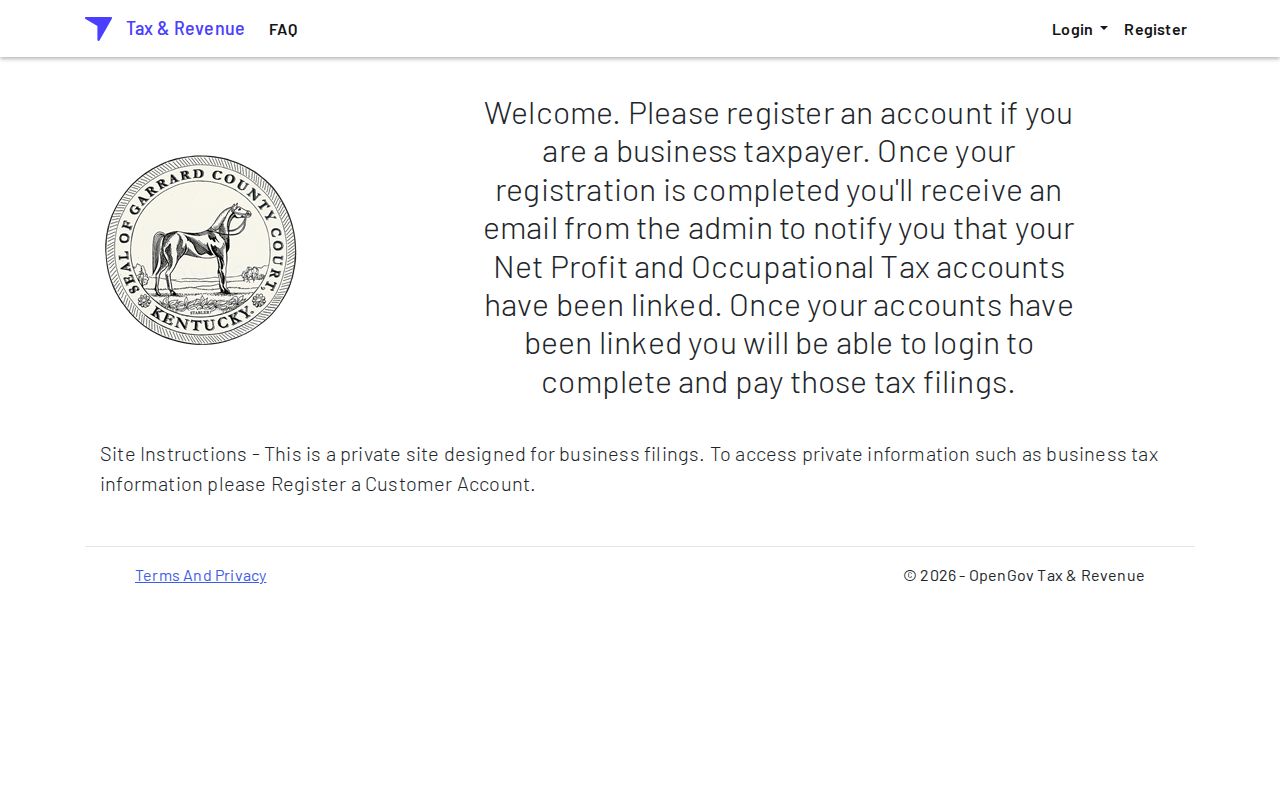
Treat the image as a map of the search modes. The live row and Sheriff confirmation are what settle a current balance question.
January 1 Anchors Garrard County Property Tax
The Kentucky Department of Revenue assessment process describes sales-comparison, cost, and income approaches. Real property is revalued every year. The PVA physically inspects each parcel at least once every four years. New construction is added annually. Farm land may qualify for agricultural value. Confirm that status from the record and the PVA rather than inferring it from acreage. The January 1 valuation and ownership date explains a common mismatch. A sale later in the year may not replace the name tied to that tax year. This holds even after a newer deed is recorded. The bill can be shown in care of a new owner. Contracts sometimes allocate responsibility differently. The newest deed and the current tax bill answer different questions. Read them side by side. Note: Garrard County publishes no fixed public timeline for a recorded deed reaching qPublic or OpenGov.
Garrard Exemptions Change Taxable Value
An eligible homeowner applies for Kentucky's homestead exemption through the PVA. The owner supplies the required proof. The DOR homestead guidance lists age and disability documentation routes. It caps the exemption at $49,100 for 2025 and 2026. That dated state amount trims taxable value. It does not shrink the property or rewrite its deed. When assessed, exempt, and taxable values appear, treat them as separate fields. Agricultural classification is distinct too, resting on Kentucky rules and the property's status. Ask the PVA how a classification or exemption applies to the specific Garrard parcel. Copying an example calculation from another record invites errors.
Follow Kentucky's Garrard Tax Collection Calendar
Under the DOR collection process, bills reach the Sheriff by September 15. Counties may also mail them in October or November. When bills go out October 1, the standard sequence offers a 2 percent discount through November 1. Face amount runs from November 2 through December 31. A 5 percent penalty begins January 5. A 21 percent penalty begins February 1. After April 15, unpaid bills transfer from the Sheriff to the County Clerk. The county attorney gives notice. The Clerk then advertises and sells delinquent bills to third parties. Annual Garrard notices and the live office status should control. A paid, corrected, removed, or sold bill can change after any list is published. Check the current record before relying on a snapshot.
The 2025 Garrard Tax Sale Was a Moving List
The 2025 Garrard tax sale shows why a dated list can mislead. A delinquent list is not a current inventory. A June notice set an August 6 sale with a July 28 registration cutoff. Fiscal Court minutes from July 28 reported 135 bills available for the 2024 tax sale. By September, the minutes reported 115 bills at the sale. 37 sold during the event and 18 more sold afterward.
Those totals describe different stages, not conflicting counts of one fixed pool. Owners may pay. Bills may be corrected or removed. Sales may close after the event. Before relying on any status, check the Garrard County Clerk delinquent-tax page. Pair it with the current annual notice. Garrard County property records like these move with time, so the newest document wins.
Note: A published sale date and bill count become historical facts. That status applies only after the notice year has passed.
A Garrard Tax Parcel Number Does Not Convey Land
A December 2025 Garrard public-sale notice states a vital local rule. The parcel or map ID and the address identify property for convenience only. When they conflict, the complete court-file legal description controls. The number on an OpenGov row is a discovery key, nothing more. It cannot settle acreage, boundary, access, or title questions in Garrard County.
For any sale or lien matter, lay the pieces side by side. Compare the PVA geometry and situs, the OpenGov tax row, the Clerk's recorded instruments, and the full court file. Obtain the sale order and legal description. Then take redemption, notice, and title questions to the responsible custodian and qualified Kentucky counsel. A tax list never substitutes for a survey or a title examination.
Route Garrard County Tax Questions to the Right Office
Route each Garrard County tax question to the office that owns it. The Garrard County PVA, Brian Swinney, sits at 319 Stanford Street in Lancaster, phone 859-792-3291, with weekday hours of 8 a.m. to 4 p.m. That office handles assessment, classification, exemption, and conference questions. The Sheriff and OpenGov handle current collection and balances. The County Clerk at 15 Public Square, Suite 5, phone 859-792-3071 or 859-792-3072, takes transferred delinquent bills and related notices.
Confirm any current amount with the collecting office itself. Never infer it from an audit, an old notice, or a partial rate table. The 2025 Kentucky rate book lists several Garrard district rates, yet a full bill can add school, city, and special-district components. To unpack what the assessment figures mean, use the Garrard County property value guide.
Verify a Garrard County Property Tax Record
Close any Garrard County property tax record review with four checks. Match the property ID to the location. Confirm the assessment year. Separate the mailing name from deed ownership. Then verify the live balance with the collecting office. If the concern is value, use the PVA conference and appeal route.
If the concern is payment, ask the Sheriff or OpenGov. If the bill has transferred, ask the Clerk about its current delinquent status. This office-by-office method also guards against stale web data. An annual notice, meeting minute, or audit can explain the process without answering a parcel's current amount. Whatever the date in question, the official record must be the last source you consult.