
Read Garrard County Deed Records by Instrument Type
The Clerk files Garrard County deed records alongside mortgages, releases, easements, plats, liens, leases, options, and powers of attorney. Each type does different work. A deed proves a conveyance happened. The instruments around it may secure, correct, or restrict that same transfer. Start with the document type. It tells you which parties, promises, and references matter.
| Deed Type | What It Does | Common Use |
|---|---|---|
| Warranty deed | Conveys the described interest with stated covenants | An ordinary sale or transfer |
| Quitclaim deed | Conveys whatever interest the grantor has | Family transfers or title cleanup |
| Correction deed | Corrects an earlier recorded instrument | Name or legal-description errors |
| Commissioner's or fiduciary deed | Transfers under court, estate, or fiduciary authority | Judicial and estate transitions |
| Deed of distribution | Documents an estate-related transfer | Passing land to heirs or beneficiaries |
Keep the whole record set in view. A mortgage or lien encumbers land without conveying it, and a release often surfaces later as its own filing. Run both parties through the general index. That way you read a transfer together with the claims and restrictions recorded around it, never in isolation.
Walk the Garrard County Grantor-Grantee Index
The County Clerk's general index runs two ways. Names appear alphabetically by grantor and by grantee, with entries in recording order. Each entry may give the party, the recording date, the instrument type, book and page, and a short description. Online, the paid eCCLIX service follows the same ideas. Its public guidance supports searching by party, date, book, type, page, and instrument number, though Garrard's exact start year and full field list are not published.
- Use qPublic to identify the parcel and current party lead, then search that party as grantee in eCCLIX.
- Open the newest deed and copy the grantor, grantee, date, deed type, legal description, and source of title.
- Search the grantor as an earlier grantee and follow the cited source deed backward.
- Check correction deeds, estate transfers, plats, easements, mortgages, liens, and releases at each step.
- Grantor
- The party transferring the described interest.
- Grantee
- The party receiving the described interest.
- Chain of title
- The linked sequence of conveyances for the same land.
- Book/page or instrument number
- The retrieval reference assigned to a recorded document.
Obtain a Garrard County Deed Copy
The Garrard County Clerk records page connects to eCCLIX and spells out the office route for official copies. Visit the Clerk at 15 Public Square, Suite 5, Lancaster, Kentucky 40444, or call 859-792-3071 or 859-792-3072 during weekday hours of 8 a.m. to 4 p.m. Staff can tell you whether the volume you need sits online, at the counter, or is best handled by a mail request. Also ask about the difference between a plain image and a certified copy.
Recorded, not guaranteed. The Garrard County index shows filed instruments, not a legal opinion on title. Unrecorded interests and unresolved defects can still exist.
eCCLIX Is Garrard County's Paid Online Deed Door
For internet access, the Clerk points to eCCLIX, a subscription service behind a login wall. Current vendor pricing includes a $200 first-county setup fee. One user pays $75 per month, or $15 for a single day. An older vendor page lists different monthly rates. Confirm the current figures before you subscribe. The public pages say nothing about the earliest Garrard instrument year, image completeness, or how often records update.
| Index lead | What to preserve | Why it matters |
|---|---|---|
| Grantor or grantee | Exact legal name and variants | Connects parties across transfers |
| Book, type, and page | Letters, zeros, and page reference | Retrieves a cited volume entry |
| Instrument number | Full formatted number | Locates a modern filing |
| Party and date | Role and recording range | Narrows common-name results |
One caution from the vendor matters. Parcel and tax-lot numbers belong to the PVA. They are not direct search fields in eCCLIX. So turn a parcel clue into a party name first. The Garrard County property lookup does exactly that. The deed search can then proceed by name. The eCCLIX login image shows the paid boundary a researcher faces at the door.
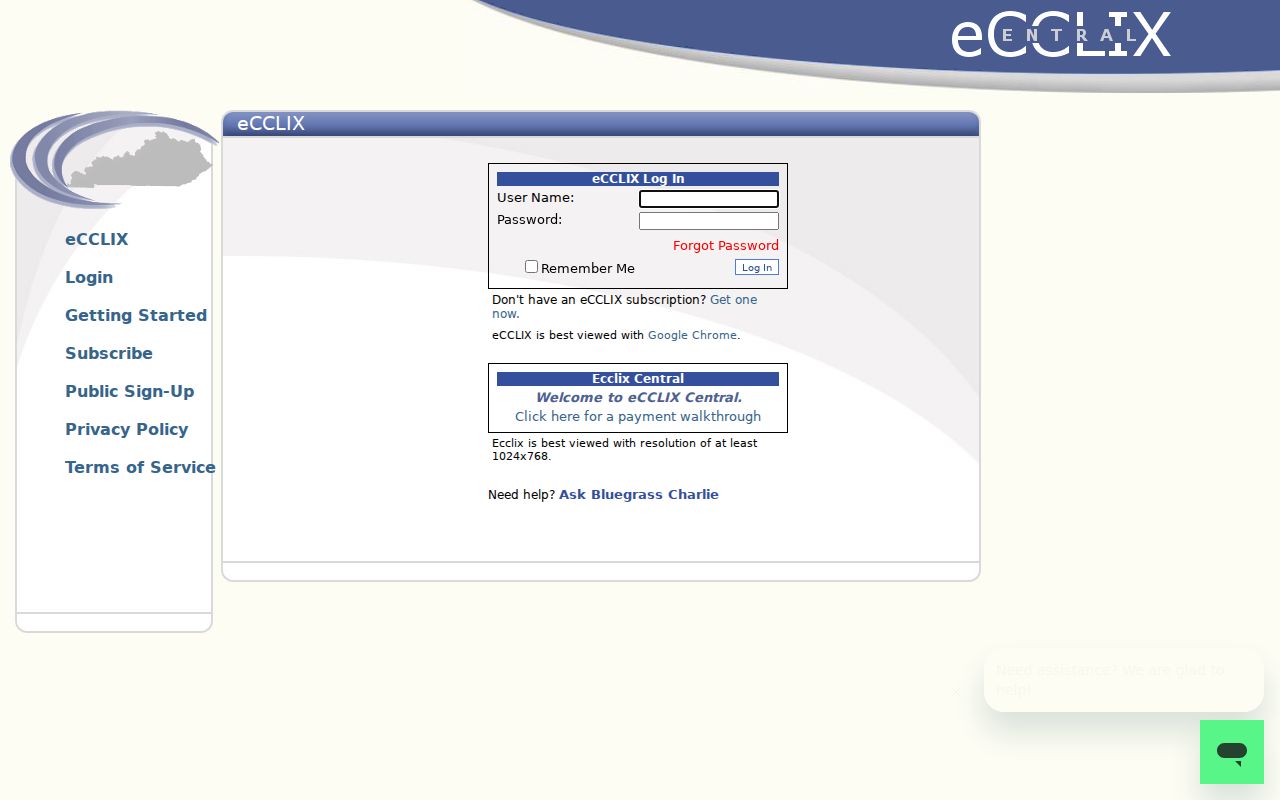
That screen proves the doorway exists. It cannot prove which Garrard books or images a given account will open.
Details to Capture from a Garrard County Deed
An index row is just a finding aid. Open the deed image. Record the instrument or book/page number, the recording date, and the instrument type. Note the grantor, grantee, and consideration. Capture the legal description and source-of-title language. Capture the return address, preparer, and signatures. Include the notary or Clerk certification. Add any attached plat or exhibit, and note prior lien or release references. These details keep a same-name stranger out of your chain of title.
Subdivision land needs extra care. Compare the lot deed against its plat book and page. Read the restrictions filed with it. For a rural tract, inspect easements, road rights-of-way, boundary agreements, mineral reservations, leases, and releases. A correction deed can change a name. It can also change a metes-and-bounds call. No new sale needs to take place. A probate order may explain a grantee who never appears in a normal sale sequence.
Note: A mailing name, mortgage borrower, or tax-roll name is a search lead. It is not proof of the deed's owner of record.
Garrard Recording Fees Are Not Copy Fees
The Clerk's posted schedule, effective January 1, 2020, lists the common recording charges. A deed costs $50 to record. A mortgage runs $80, and a mortgage with assignment runs $126. An affidavit of descent is $50, and so is a plat or easement. Each page beyond the first five adds $3. Marked instruments over 30 pages follow a separate rule. These are fees to record, not quoted prices for plain or certified copies.
KRS 64.012 sets the state baseline for these charges. The Clerk's current page governs the practical county schedule at the time of service. Request a quote that spells out certification, page count, postage, and the instrument involved. Separately, the local Open Records Policy lists $0.50 noncommercial copies. It also adds its own media and advance-payment terms.
Garrard Deed Books Extend Beyond the Web Index
Online indexes only reach so far. The FamilySearch Garrard land-record catalog lists deed books from 1801 through 1901. Its general indexes begin in 1799 or 1800 and run to 1920. Its index volumes split the older run into dated spans. Whether images open up depends on the item, your account, and where you view it. Treat the catalog as a backstop. It is not a promise that every Garrard County book is freely viewable online.
Garrard County was formed in 1796 from Lincoln, Madison, and Mercer Counties. Trace a title older than that in the parent counties. Probate records beginning in 1797 can fill estate-related gaps. Tax books run from 1797 through 1875. They may show when a name entered or left the land-tax rolls. The digitized and microfilmed catalog listing works as a finding aid. It covers these older deed books.
Dates narrow the volume you need. The Clerk's permanent archive and the recorded entry still stand as the official local record for Garrard County.
Monitor New Garrard Deeds with DOC ALERT
The Clerk's records page offers free DOC ALERT monitoring for a personal or business name. Signup needs a name, email, and the party to watch. The service then sends notice whenever a deed or mortgage bearing that name is recorded. It earns its keep after a refinance, correction, or entity-name change.
An alert blocks nothing. It also proves no fraud. A notice may cover a valid release, trustee filing, or similarly named party. Pull the instrument itself. Compare the signer, notary, preparer, legal description, and prior deed. If a filing is not recognized, contact the Clerk. Also seek appropriate legal or law-enforcement help.
Request Garrard County Land Records from the Custodian
If a deed image or index range is not online, reach the County Clerk by phone, mail, or in person. You can also stop at the counter. Provide party names, an approximate date, and the instrument type. Include any book/page or instrument reference you already have. A narrow request helps staff pull the right volume. Keep in mind a parcel number is not a recorder search field here.
The Garrard Clerk Open Records Policy allows five working days for a determination. It covers copies, media, postage, commercial-purpose certification, and advance payment. Kentucky's Open Records Act supplies the wider custodian framework. Neither rule opens a restricted record. It does not make the Clerk custodian of court, PVA, or Sheriff files.
Confirm the Garrard County Title Trail
Close the chain by comparing the legal description, source deed, plat, and every referenced encumbrance. A recording proves only what reached the Clerk. A survey handles physical boundary work. A title examination settles the legal effect. The parcel-map label never outranks the deed just because it reads easier.
Court-ordered and tax-related transfers need the court file and sale order too. Garrard's 2025 public-sale notice puts the hierarchy plainly. The parcel and map ID are convenience details. The complete court-file legal description controls when they differ. That local warning fits every Garrard County deed search.