
Trace Garrard County Former Owners
Work backward one deed at a time. Garrard County former owners surface most clearly in the deed books. The Garrard County Clerk keeps a general grantor-grantee index for exactly that purpose. Tax books help. Plats and probate files bridge gaps too. But each serves a different role. A tax entry shows who was assessed in a given year, while a probate file explains why land passed through heirs before the next deed was signed, and neither alone proves title.
| Ownership source | Documented span | Access point | Best use |
|---|---|---|---|
| County Clerk deed index and books | Permanent series; online start not published | Clerk office and paid eCCLIX service | Grantor, grantee, deed references, and the legal transfer |
| FamilySearch deed books and indexes | Books 1801-1901; indexes 1799/1800-1920 | FamilySearch catalog, with item access limits | Earlier deeds and name-to-volume references |
| Garrard probate files | Probate 1797-1923; indexes through 1958 | FamilySearch catalog, Clerk, and archives | Estate land, heirs, divisions, and commissioner transfers |
| Garrard tax books | 1797-1875 | FamilySearch microfilm catalog | A year-by-year clue when the deed chain is hard to follow |
Start with the newest deed. Its source-of-title clause may point to an earlier book, page, or instrument. Spellings wander in old records. Preserve each variant and consult the Garrard land-record catalog when nineteenth-century owners appear. An old tax list supports the trail but never replaces the deed itself, and an estate calls for the probate index before assuming the chain broke.
Garrard's Two Ownership Keys
Garrard former-owner research crosses two indexing systems. The PVA side organizes land by address and parcel key. The Clerk side organizes instruments by party, book and page, document type, or instrument number. eCCLIX guidance states plainly that a PVA tax-lot number is not a land-index search field. Key 65-076 finds a tract on the map. The same key may fail as an eCCLIX query.
Copy the owner lead from qPublic or OpenGov. Search that exact person or entity as a grantee in the deed index. The deed's prior grantor then supplies the next name. That parcel-to-party handoff is the core Garrard technique. It also keeps a mailing-name row or map label from being mistaken for proof of an earlier owner.
Note: Keep the parcel key and deed reference side by side, since each answers a different question about the same land.
Garrard Deed Books Beyond eCCLIX
The public eCCLIX pages never state the earliest Garrard instrument online. That gap is not a cutoff date. Guessing one only hides deeds. The Clerk's permanent books remain the fallback, supported by general indexes held locally. FamilySearch catalogs Garrard deed books from 1801 through 1901. General indexes run from 1799 or 1800 through 1920. The older-chain catalog entry maps that finding-aid layer. Some images depend on account or viewing location.
Use the catalog's volume and index ranges. Request the right book accordingly. The Clerk, KDLA, or an eligible FamilySearch access point can supply volumes, though catalog coverage never promises that every image opens from home.
Online coverage has an open edge. Garrard's earliest eCCLIX year was not published in the reviewed public pages; older owners may require Clerk books, microfilm, or archival access.
Reverse the Garrard Deed Chain
A backward chain treats every deed as a link. No deed stands alone. Begin with the present parcel and its latest recorded conveyance. The grantee bought; the grantor sold. To find prior owners, take that grantor's exact name and locate the deed through which the same tract was earlier acquired.
- Find the latest deed with the current owner named as grantee. Match the parcel through its legal description, not just the street address.
- Record the grantor, recording date, deed type, book/page or instrument number, and source-of-title reference.
- Search that grantor as an earlier grantee. Compare the land description, acreage, plat, and adjoining owners before accepting the match.
- Repeat the sequence. When eCCLIX coverage or image access ends, carry the last book/page reference into Clerk books or archival indexes.
- Grantor and grantee
- The transferring party and the receiving party named in a deed.
- Chain of title
- The linked sequence of instruments through which ownership passed.
- Reverse index
- An index arranged to find the other side of a recorded transfer by party name.
- Warranty and quitclaim deeds
- Different conveyance forms; neither label alone proves the full quality of title.
- Legal description
- The land description that identifies the tract more firmly than a changeable street label.
The Clerk records far more than deeds. Mortgages, easements, plats, liens, releases, leases, and powers of attorney all sit in the same books. A clean chain may still need them. Each serves a distinct role. A correction deed can change a name, an easement can affect the tract without transferring it, and a release can close a lien.
Garrard Prior Owners Through Estates
Death interrupts a simple seller-to-buyer pattern. Court-directed transfers do too. Garrard probate materials begin in 1797, with files cataloged through 1923 and indexes through 1958. Search for wills, inventories, estate land divisions, guardianships, affidavits of descent, deeds of distribution, and commissioner deeds when an owner vanishes from the deed sequence.
A probate record explains why heirs could transfer land. The later recorded deed or court order still anchors the parcel match. Executor, administrator, trustee, guardian, heir, and commissioner are roles. Not every named person held the property individually. Compare dates and the full legal description before assigning ownership.
Before Garrard County Had Records
Garrard County was formed in 1796. Its land came from Lincoln, Madison, and Mercer counties. A title reaching farther back may leave the Garrard books entirely, even though the land never moved. The predecessor county depends on where the tract lay under the older boundary.
This is a time-depth trap. Searching only "Garrard" hides valid deeds. Use the oldest confirmed Garrard deed for direction. Its source-of-title language, adjoining owners, watercourses, road calls, and metes-and-bounds description point to the next archive. Preserve old spellings, and never force an early tax-list name onto a modern parcel without connecting instruments.
Tax Books as Garrard Owner Clues
Garrard tax books cover 1797 through 1875. They show when a name first appears in an area. They also show when a name drops away. That alone helps bracket a transfer. It matters most when a source-of-title citation is thin, a deed is barely legible, or an estate sat on land between recordings. A separate Garrard tax list from 1890 adds one more dated lead. The Garrard tax-book catalog shows the microfilm route for this kind of supporting evidence.
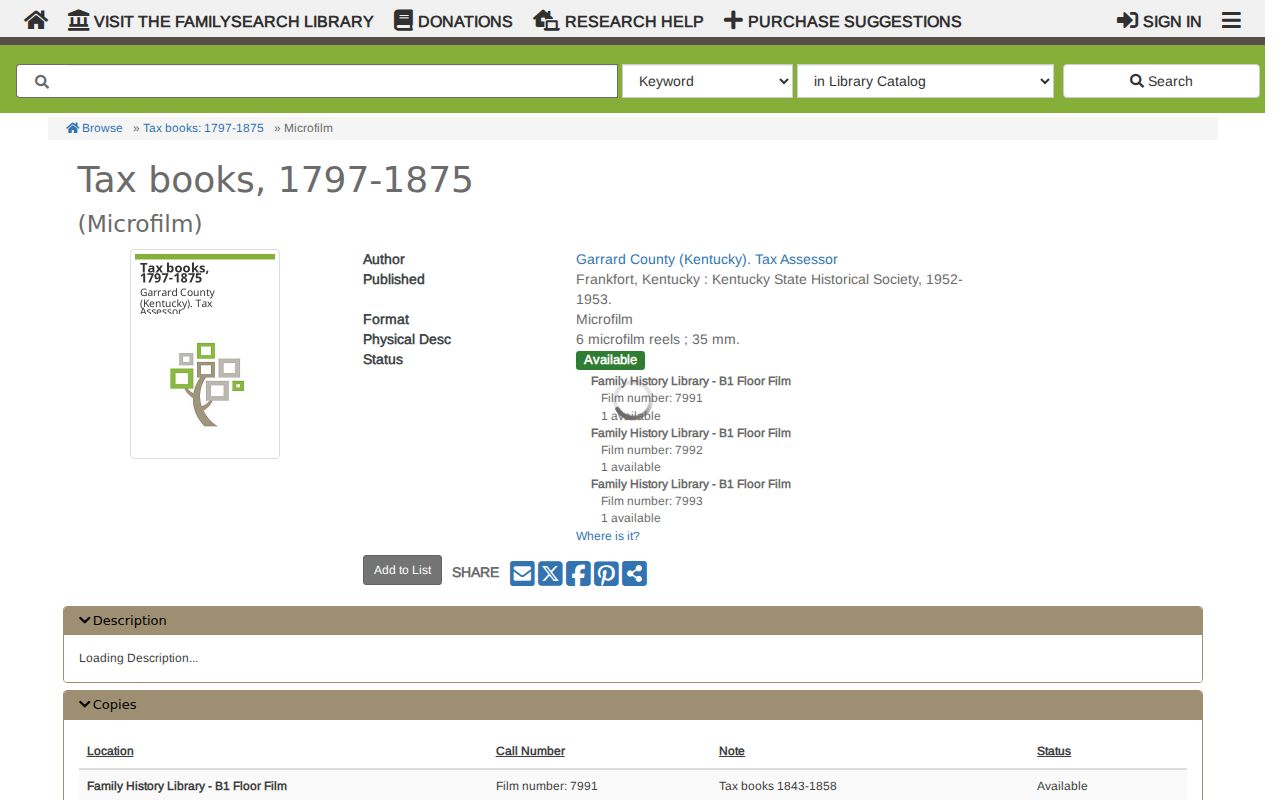
A tax-book name could be an owner, a taxpayer, or an estate. Pin the former owner down with a deed, probate transfer, or court order tied to the same land.
Search Garrard Previous Owner Names
A missing result does not always mean a missing record. Garrard County indexes often need a different key. Try initials instead of full given names, or the reverse. Married names, former names, and spelling variants all matter. Searching grantor and grantee roles in both directions helps too. The name you expect may sit on the other side of the deed.
Businesses take extra care. Copy the exact legal name from the deed. Then run it through the Kentucky business search, checking active and inactive profiles alike. A dissolved entity can still be the correct historic grantee. If nothing turns up, consider a parcel that split or merged, a road name that changed, or an instrument outside online coverage. Widen the date range and try again. An empty result only means the path needs another key. It never proves Garrard County had no prior owners.
Limits of Garrard Ownership History
Garrard County former owners can be traced through several layers. But no single unbroken online chain exists. Garrard records show no courthouse fire. There was no reindexing event. And no complete digitization cutover. eCCLIX publishes no public start year for Garrard deeds either. State retention rules make deed and index series permanent. That speaks to custody, not web access.
Street addresses shift. Parcel shapes get redrawn. Tax names change while the land description persists. A map is a discovery aid. A tax entry is a dated clue. The recorded deed remains the stronger evidence. So does its referenced plat, a probate instrument, or a court order. For a current legal conclusion, follow the Garrard deed records route. Get qualified title help.
Lawful use. Research former owners for house history, estate work, boundaries, and purchase diligence. Never use ownership records to stalk, harass, or harm a living person.